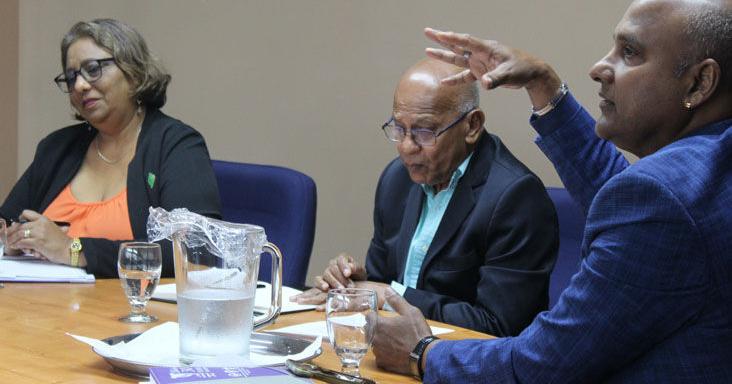
THE Environmental Management Authority (EMA) this week held talks with major upstream oil and gas operators in the country to address complaints that its permitting process has grown slow and cumbersome.
“The meeting also provided an opportunity for the Authority to outline the operational constraints and regulatory considerations that impact the timely processing of applications and post-CEC requirements. This engagement forms part of the EMA’s ongoing commitment to strengthening collaboration, enhancing transparency, and improving the overall efficacy of the CEC permitting framework,” a release from the EMA stated yesterday.
The meeting held on Tuesday was led by EMA chairman, Doolar Ramlal, alongside acting managing director Wayne Rajkumar, and members of the Certificate of Environmental Clearance (CEC) Unit.
Representatives were invited from BP Trinidad and Tobago LLC (BPTT), EOG Resources Trinidad Ltd, Lease Operators Ltd, Heritage Petroleum Company Ltd, 360 Oil and Gas Ltd, A&V Oil and Gas Ltd, ExxonMobil Trinidad and Tobago Deepwater Ltd (ExxonMobil), Perenco Trinidad and Tobago Ltd, Touchstone Exploration (Trinidad) Ltd, Summit Energy Services Ltd and Shell Trinidad & Tobago Ltd.
“Chairman Ramlal reaffirmed the board of directors’ commitment to improving the timeliness and effectiveness of application processing and determinations, while supporting the Government’s thrust to enhance the ease of doing business and advance sustainable development in alignment with the national priorities of Trinidad and Tobago. He emphasised the critical role of stakeholder feedback in identifying practical measures to refine the CEC process and strengthen the broader environmental management framework,” it stated.
The EMA’s Knowledge Management manager, Nisha Ramsahai, highlighted that a principal challenge within the permitting process relates to the collection, management, and effective sharing of baseline environmental data.
Ramsahai said the EMA intends to establish a structured data repository to allow more seamless information sharing among stakeholders, improving efficiency and reducing duplication.
“Ms Sally Maharaj, environmental programmer officer III, further observed that while operators often possess the necessary data, there can be uncertainty regarding the specific datasets required and the format in which they should be submitted. She emphasised that clearer guidance, stronger coordination, and improved communication between the Authority and operators are essential to ensuring comprehensive and compliant submissions,” the EMA stated.
“Additional discussions addressed the current five-year data period applied in the Authority’s assessments, including consideration of whether this timeframe warrants review, as well as the importance of engaging suitably qualified consultants to support the preparation of applications,” it stated.
The EMA said that the operators participated openly and constructively in the dialogue.
“Mr Glenn Goddard, environmental and social discipline lead for bpTT, acknowledged the EMA’s receptiveness to industry concerns and described the meeting as productive. He commended the Authority’s open communication and collaborative approach, expressing optimism that the discussions would lead to meaningful enhancements in the CEC process,” it stated.