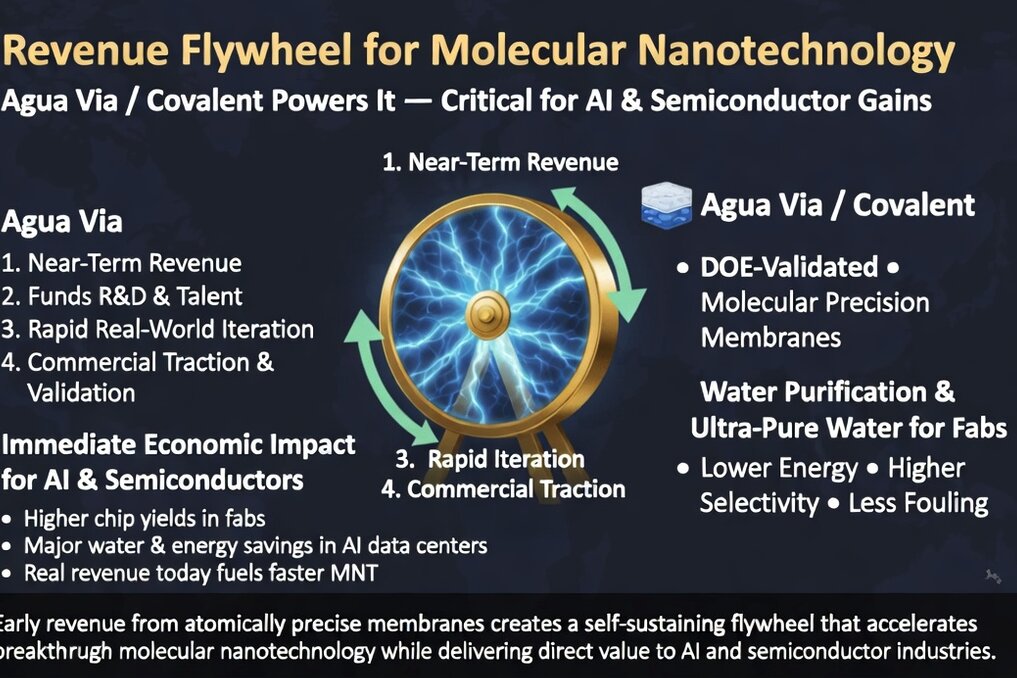
I make the case the critical factor is creating a revenue producing flywheel as soon as possible. Creating near-term revenue-generating applications of molecular precision is one of the most effective ways to build a self-sustaining flywheel for molecular nanotechnology (MNT). Agua Via / Covalent represents a credible example of this approach. The diamondoid roadmap is not the fastest path to a revenue producing flywheel, particularly a flywheel of revenue tied into the recursively improving AI technology stack.
Why a Revenue-Producing Flywheel Is Critical
Most historical MNT efforts (diamondoid mechanosynthesis, positional assembly, full nanofactories) have followed a grant/VC-funded, long-timeline model. This creates several problems.
High technical risk with distant payoffs.
Difficulty attracting and retaining top talent over decades.
Limited ability to iterate quickly (recursive improvement).
Dependence on external funding cycles.
A revenue flywheel changes the dynamics.
Early products generate cash that funds R&D.
Commercial traction validates the technology and attracts better capital and partners.
Real-world use cases drive rapid iteration and capability building.
It creates a positive feedback loop where success funds more ambitious work.
Agua Via / Covalent
Agua Via (with technology from Covalent LLC) is developing one-atomic-layer-thick, atomically precise organic membranes using pharmaceutical-style chemistry and self-assembly.
They have been DOE-validated. The U.S. Department of Energy has reviewed their membranes positively, with one review calling it “the most atomically-precise material ever built.”
Molecular precision. These are not conventional polymer membranes. They use designed molecular building blocks to create highly uniform pores with atomic-level control over size, shape, and chemistry.
Performance claims are extremely low energy use (potentially gravity-driven in some configurations), high selectivity, reduced fouling, and significantly lower operating costs compared to reverse osmosis or other current technologies.
Target applications are Water purification, desalination, and industrial separations.
This is real molecular precision manufacturing being applied to a massive, immediate market (water treatment), rather than waiting for full diamondoid assemblers.
Semiconductor fabs are extremely sensitive to water purity. Ultra-pure water is critical for yield. Even small improvements in membrane performance can translate to higher yields. Semiconductor fabs represent tens to hundreds of billions in annual value, and the broader AI/semiconductor ecosystem is multi-trillion.
AI data centers consume enormous amounts of water for cooling. Better purification and recycling technologies have direct economic value.
These are capital-rich, high-urgency customers willing to pay for meaningful improvements in yield, energy efficiency, or cost. This creates a realistic path to revenue today.
The Feynman Grand prize is $250,000. Providing a leap in the water and air sections semiconductor fabs would be worth tens of billions.
Atomically precise membranes are already at a more advanced stage of productization than most diamondoid MNT work. Success here builds manufacturing know-how, supply chains, and credibility that can support more ambitious MNT later. The AI boom creates urgent, well-funded demand for anything that improves fab yield or data center efficiency.
Summary of Progression of the CBN Diamondoid Roadmap
Phases I–II: Macroscale validation of mechanosynthesis
Phases III–IV: Transition to nanoscale systems + bulk feedstock
Phases V–VI: Nanoscale assembly and self-contained manufacturing
Phases VII–VIII: Replication and exponential scaling
Phases IX–XI: Larger products and full desktop nanofactories
Brian Wang is a Futurist Thought Leader and a popular Science blogger with 1 million readers per month. His blog Nextbigfuture.com is ranked #1 Science News Blog. It covers many disruptive technology and trends including Space, Robotics, Artificial Intelligence, Medicine, Anti-aging Biotechnology, and Nanotechnology.
Known for identifying cutting edge technologies, he is currently a Co-Founder of a startup and fundraiser for high potential early-stage companies. He is the Head of Research for Allocations for deep technology investments and an Angel Investor at Space Angels.
A frequent speaker at corporations, he has been a TEDx speaker, a Singularity University speaker and guest at numerous interviews for radio and podcasts. He is open to public speaking and advising engagements.