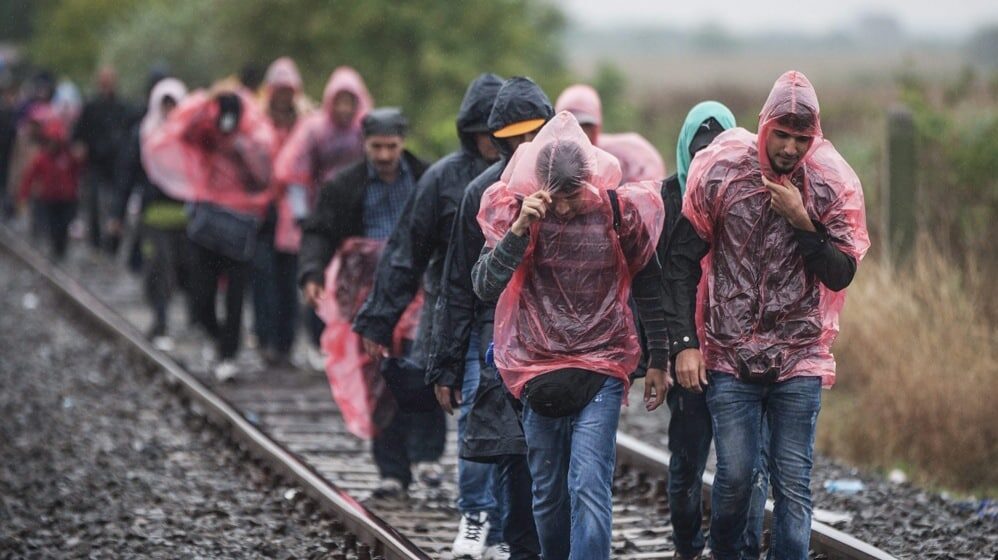
In the first half of this year, EU member states plus Norway and Switzerland received 399,000 applications for international protection, a 23 per cent decrease from the year-earlier period, according to data released by the European Union Agency for Asylum (EUAA) on Monday.
If extrapolated for the whole year, the figure would imply a fall from the million-plus asylum applications received in 2023 and 2024, which were consistent with the record numbers seen during the migration crisis of 2015-2016.
“Europe’s asylum landscape underwent a series of significant shifts in the first half of 2025,” the EUAA wrote in its mid-year report. “Following the ousting of the Assad regime in December 2024, far fewer Syrians applied for asylum during the first half of 2025.”
“A majority of applications continued to be lodged by citizenships with low recognition rates in the EU+… [and] the EU+ recognition rate for the first half of the year stood at 25 per cent, which is the lowest overall semi-annual or annual recognition rate on record,” it said.
The new data showing the fall in asylum applications comes as anti-immigration parties across Europe are gaining support, including in the Czech Republic where a general election will be held next month. In Poland, the recent presidential election, ultimately won by Karol Nawrocki, was dominated by candidates who want tighter immigration controls.
The EUAA said that bucking the falling trend were 16,000 applications from Ukrainians, who lodged 29 per cent more during the 12 months leading up to June. France accounted for nearly half of all Ukrainian asylum applications, whereas Poland accounted for almost a third.
The 399,000 asylum applications during the first half of 2025 translate to nearly 859 applications per million inhabitants, or one application per 1,164 residents. Hungary, the agency noted, stands out among EU+ countries for allowing an exceptionally low number of asylum-seekers to lodge applications, just 47 during the first half of 2025 despite a population exceeding 9.5 million. “This is likely due to Hungary’s special rules which limit access to the asylum procedure by requiring applicants to submit a letter of intent at a Hungarian diplomatic mission in a non-EU country prior to their entry to Hungary,” it said.
The EU+ countries also grant temporary protection, which the Council of the EU has extended for Ukrainians fleeing Russia’s aggression against Ukraine until March 2027.
At the end of June there were about 4.5 million beneficiaries of temporary protection in the EU+ who had fled Ukraine following Russia’s full-scale invasion. Nearly half of all beneficiaries of temporary protection were in Germany (1.2 million) and Poland (just under 1 million). Czechia hosted the most beneficiaries per capita (35,000 per million inhabitants, or 1 beneficiary for every 29 residents). Slovakia was hosting a much lower number of beneficiaries (133,000) yet exhibited a similar per-capita distribution of 1 beneficiary for every 41 residents.