Coal and natural gas production hubs in Australia, one of the top exporters of the fossil fuels, should diversify their economies and can’t rely on potential new industries such as green hydrogen to preserve jobs, according to a study.
(Bloomberg) — Coal and natural gas production hubs in Australia, one of the top exporters of the fossil fuels, should diversify their economies and can’t rely on potential new industries such as green hydrogen to preserve jobs, according to a study.
THIS CONTENT IS RESERVED FOR SUBSCRIBERS ONLY
Subscribe now to read the latest news in your city and across Canada.
- Exclusive articles by Kevin Carmichael, Victoria Wells, Jake Edmiston, Gabriel Friedman and others.
- Daily content from Financial Times, the world’s leading global business publication.
- Unlimited online access to read articles from Financial Post, National Post and 15 news sites across Canada with one account.
- National Post ePaper, an electronic replica of the print edition to view on any device, share and comment on.
- Daily puzzles, including the New York Times Crossword.
SUBSCRIBE TO UNLOCK MORE ARTICLES
Subscribe now to read the latest news in your city and across Canada.
- Exclusive articles by Kevin Carmichael, Victoria Wells, Jake Edmiston, Gabriel Friedman and others.
- Daily content from Financial Times, the world’s leading global business publication.
- Unlimited online access to read articles from Financial Post, National Post and 15 news sites across Canada with one account.
- National Post ePaper, an electronic replica of the print edition to view on any device, share and comment on.
- Daily puzzles, including the New York Times Crossword.
REGISTER TO UNLOCK MORE ARTICLES
Create an account or sign in to continue with your reading experience.
- Access articles from across Canada with one account.
- Share your thoughts and join the conversation in the comments.
- Enjoy additional articles per month.
- Get email updates from your favourite authors.
A global rush to add more cleaner energy sources will threaten regions that depend heavily on traditional industries, and better coordination is needed with local and national governments to boost innovation and prepare for shifts in employment, the Centre for Policy Development said Thursday in a report.
Financial Post Top Stories
Sign up to receive the daily top stories from the Financial Post, a division of Postmedia Network Inc.
By clicking on the sign up button you consent to receive the above newsletter from Postmedia Network Inc. You may unsubscribe any time by clicking on the unsubscribe link at the bottom of our emails or any newsletter. Postmedia Network Inc. | 365 Bloor Street East, Toronto, Ontario, M4W 3L4 | 416-383-2300
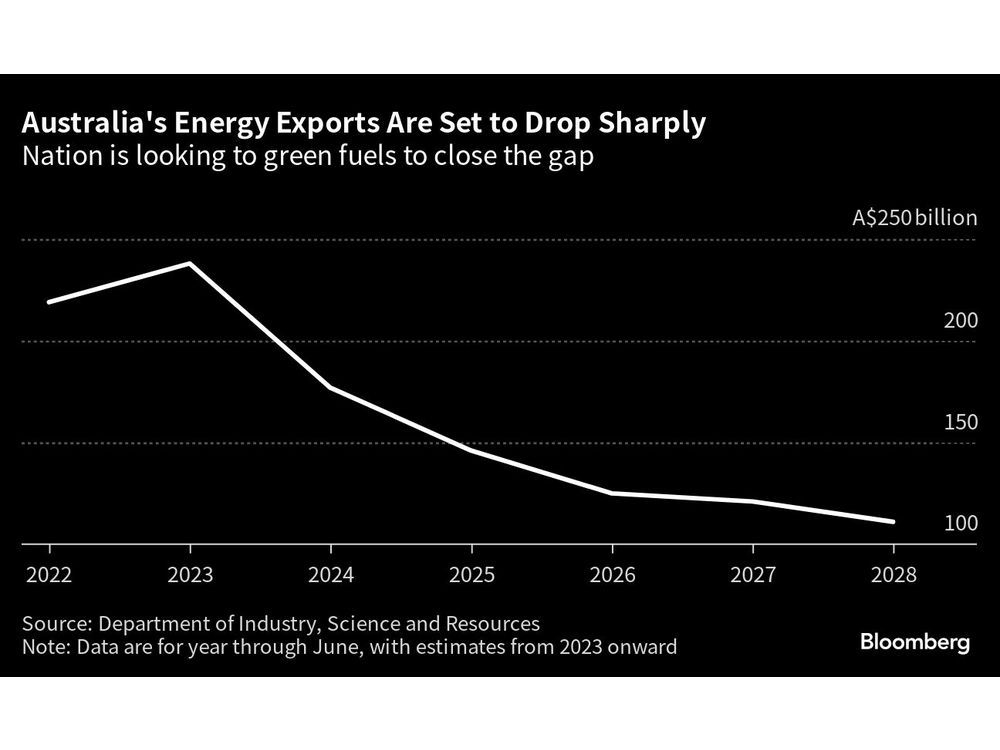
Prime Minister Anthony Albanese’s government has pledged more than A$525 million ($348 million) to develop a hydrogen sector, and is targeting funding at many existing fossil fuel or mining centers, including the Hunter Valley in New South Wales and Western Australia’s Pilbara region. That funding pales in comparison with the nation’s current energy exports, which are forecast to reach a record A$238 billion in the year through June before falling rapidly.
The government’s plans envisage jobs in coal mines, power plants or gas facilities replaced by employment in clean energy equipment manufacturing, or in the production of zero-emissions hydrogen to be used as an energy source or feedstock for heavy industry.
“If the new anchor industry does not take off or succeed, communities are back at square one,” the think tank said in its report, following a study of 11 local government areas in Australia exposed to the energy transition. “It is critical to build a community’s economic resilience and adaptive capacity more generally.”
Australia employed about 49,616 people in coal mining and a further 18,693 in gas and oil exploration as of 2021, according to the report. They represent less than 3% of the total workforce in all but two of the nation’s 566 local government areas.
While the growth in renewables will deliver new jobs, those are likely to be unevenly distributed and often temporary — because projects typically require lower levels of staff for operations and maintenance after their initial construction, the Committee for Economic Development of Australia said in February.