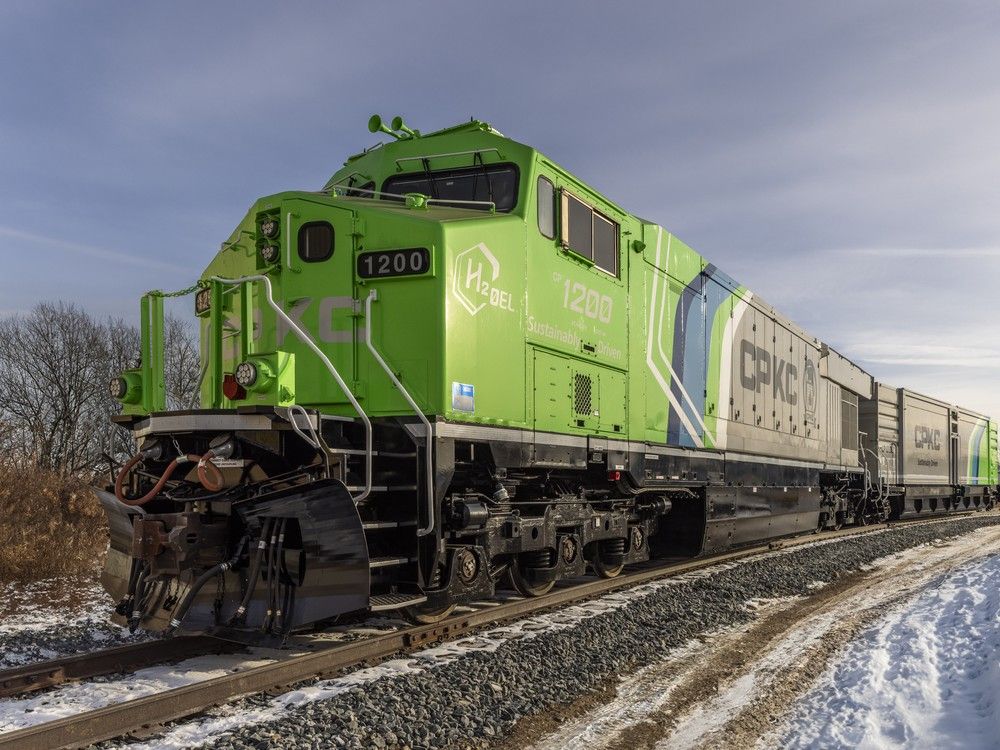
Canadian Pacific Kansas City railway plans to start rolling out hydrogen-powered locomotives after its first test was a success
Published Nov 15, 2024 • Last updated 1 week ago • 4 minute read
One of Canada’s major railroads recently marked a big first by successfully testing a hydrogen-powered locomotive on one of its lines, with it pulling a train along the company’s Western Canada corridor.
Hydrogen-powered transportation has been around since the 1800s, but has yet to be commercially viable despite many attempts. Canadian Pacific Kansas City Ltd.‘s hydrogen locomotive project only dates back to 2020 and is, as chief executive Keith Creel said in September, designed to showcase the company’s commitment to leadership and sustainability.
THIS CONTENT IS RESERVED FOR SUBSCRIBERS ONLY
Subscribe now to read the latest news in your city and across Canada.
- Unlimited online access to articles from across Canada with one account.
- Get exclusive access to the Saskatoon StarPhoenix ePaper, an electronic replica of the print edition that you can share, download and comment on.
- Enjoy insights and behind-the-scenes analysis from our award-winning journalists.
- Support local journalists and the next generation of journalists.
- Daily puzzles including the New York Times Crossword.
SUBSCRIBE TO UNLOCK MORE ARTICLES
Subscribe now to read the latest news in your city and across Canada.
- Unlimited online access to articles from across Canada with one account.
- Get exclusive access to the Saskatoon StarPhoenix ePaper, an electronic replica of the print edition that you can share, download and comment on.
- Enjoy insights and behind-the-scenes analysis from our award-winning journalists.
- Support local journalists and the next generation of journalists.
- Daily puzzles including the New York Times Crossword.
REGISTER / SIGN IN TO UNLOCK MORE ARTICLES
Create an account or sign in to continue with your reading experience.
- Access articles from across Canada with one account.
- Share your thoughts and join the conversation in the comments.
- Enjoy additional articles per month.
- Get email updates from your favourite authors.
THIS ARTICLE IS FREE TO READ REGISTER TO UNLOCK.
Create an account or sign in to continue with your reading experience.
- Access articles from across Canada with one account
- Share your thoughts and join the conversation in the comments
- Enjoy additional articles per month
- Get email updates from your favourite authors
Sign In or Create an Account
or
Article content
CPKC has made commitments to reduce its carbon emissions while working towards net-zero emissions, and rolling out hydrogen-powered locomotives is an important part of the pledge since emissions from diesel locomotives account for a large portion of the company’s overall emissions.
“Burning diesel accounts for 92 per cent of our Scope 1 emissions,” Kyle Mulligan, assistant vice-president of CPKC’s operations technology team, said.
He said the decision to try hydrogen instead of electric was made for a practical reason, which is that having fixed recharging stations for locomotives will not allow for smooth operations. Hydrogen, however, can be loaded like diesel fuel into a locomotive from a truck.
“The portability of hydrogen was immediately something of interest,” he said.
Hydrogen was also preferable to electric because recharging a large locomotive would be a time-consuming process and would have required CKPC to build additional infrastructure.
“The refueling time of a hydrogen locomotive is equivalent to a diesel locomotive,” Mulligan said.
By signing up you consent to receive the above newsletter from Postmedia Network Inc.
Article content
Article content
In constructing a hydrogen locomotive, he said the company simply converted one of its diesel-powered units, which involved switching out the engine and other power components.
“We drop in these integrated, pre-assembled skids of fuel cells, batteries, power electronics and hydrogen gas cylinders,” he said.
The fuel cell uses hydrogen gas and oxygen, which react with the fuel cell to produce electricity along with water vapour and heat. The locomotive’s onboard batteries also capture energy through regenerative braking, a source of energy that is not captured on a traditional diesel-powered locomotive.
If needed, Mulligan said the fuel cells and batteries can work together when a train needs to climb a large incline.
“For high, high-intense applications, we actually blend the power of the fuel cells and the batteries,” he said.
Mulligan said CPKC made the decision to test its first hydrogen locomotive on one of its routes in British Columbia, running from the coal mines in the southeast of the province to Vancouver, since it would allow it to be tested in a number of different situations that are common across its operations in the Western provinces.
Article content
Overall, he said the new locomotive performed well while working alongside diesel-powered machines.
“We were actually pulling our weight within that train as if we were a diesel locomotive,” he said.
Currently, CPKC has a total of three hydrogen-powered locomotives. Mulligan said the company has commissioned the construction of its first production high-horsepower hydrogen locomotive, which is expected to be deployed in B.C. next year, with more expected to follow in the coming years.
“We’ll continue to sort of build those out at one per year,” he said.
Mulligan said CKPC is also planning to roll out more lower-horsepower hydrogen locomotives across the Western provinces to compliment the two already in service. Those would be primarily used to move rail cars around terminals as opposed to pulling trains.
“Over the next two years, you’ll start to see a ramp up in those conversions and deployments of those locomotives in Calgary, Edmonton, Lethbridge and Golden,” he said.
Rolling out the new locomotives should create some long-term cost savings for CPKC because they do not require as much maintenance as diesel-powered units. Another plus is that the cost of hydrogen has dropped.
Article content
“In four years, the cost of a kilogram of hydrogen for us has lowered by 50 per cent,” he said.
Recommended from Editorial
Canada’s other major railway is also taking steps to cut its carbon emissions. Canadian National Railway Co. said it is committed to net zero and is working to bring in new technologies to work towards this goal.
“Thus far, CN has announced the purchase of a battery-electric locomotive and a hybrid locomotive,” the company said in an email.
The company also said its testing of these technologies will increase its knowledge of batteries, which will help develop alternative ways of powering locomotives.
“CN anticipates this initiative will contribute to further developing this key technology while immediately reducing emissions,” the company said.
Editors Note: This story was amended on Nov. 15 to add that CPKC has a total of three hydrogen locomotives in service.
The Saskatoon Star Phoenix has created an Afternoon Headlines newsletter that can be delivered daily to your inbox so you are up to date with the most vital news of the day. Click here to subscribe.
With some online platforms blocking access to the journalism upon which you depend, our website is your destination for up-to-the-minute news, so make sure to bookmark thestarphoenix.com and sign up for our newsletters so we can keep you informed. Click here to subscribe.
Article content